Most people know to call a general dentist when they have a cavity or need a cleaning, but when dental challenges become more complex, many patients wonder whether a different level of care is required. A prosthodontist is a dental professional who has completed an additional three-year residency beyond dental school, focusing entirely on the restoration and replacement of teeth, which means cases involving significant tooth loss, full-arch reconstruction, or complex aesthetic transformations fall squarely within this field.
At Manhattan Aesthetic Dentistry, Dr. Nargiz Schmidt, DDS, brings over 20 years of experience in prosthodontics to patients throughout Midtown East and beyond. As the author of Fearless Smile: Overcoming Dental Phobia and an internationally recognized lecturer in minimally invasive aesthetics and full-arch implant procedures, Dr. Schmidt has built her practice on a fundamental belief that complex cases deserve a specialist’s precision, not a generalist’s approximation. Patients who visit our prosthodontic practice benefit from a fully digital treatment workflow and a clinician whose entire career has been devoted to the most demanding cases in restorative and aesthetic dentistry.
What Does a Prosthodontist Actually Do?
Prosthodontics is one of the 12 recognized dental specialties acknowledged by the American Dental Association, which means that earning this credential requires significant postgraduate commitment beyond a standard dental degree. According to the American Dental Association, prosthodontists receive specialized training in dental implants, restorative materials, and the full scope of clinical scenarios involving missing or deficient teeth. A prosthodontist’s scope of work extends well beyond routine fillings and preventive care, encompassing some of the most technically demanding procedures in modern dentistry.
Restoration and Replacement of Teeth
The core focus of prosthodontics is restoring what is missing. It may be a single tooth lost to decay or an entire arch of teeth lost over years of health challenges. Prosthodontists design and place crowns, bridges, and veneers with precision informed by their deep understanding of bite mechanics, materials science, and aesthetic proportion. When teeth are irreparable, prosthodontists also coordinate and oversee dental implant placement and restoration, ensuring the final result functions and appears entirely natural.
Full-Arch and Complex Reconstruction
When multiple oral systems are compromised, a prosthodontist becomes the central coordinator of care. Full-mouth reconstruction may involve a combination of implants, crowns, bridges, and soft-tissue management, performed in collaboration with oral surgeons and periodontists. The prosthodontist’s role is to oversee the comprehensive treatment plan, ensuring every component integrates seamlessly in both form and function.
When Should You See a Prosthodontist Instead of a General Dentist?
The distinction often comes down to complexity. General dentists are exceptionally well-equipped to manage the routine dental health of most patients, but certain presentations require the additional training and clinical depth that prosthodontics provides.
Signs You May Benefit From Prosthodontic Care
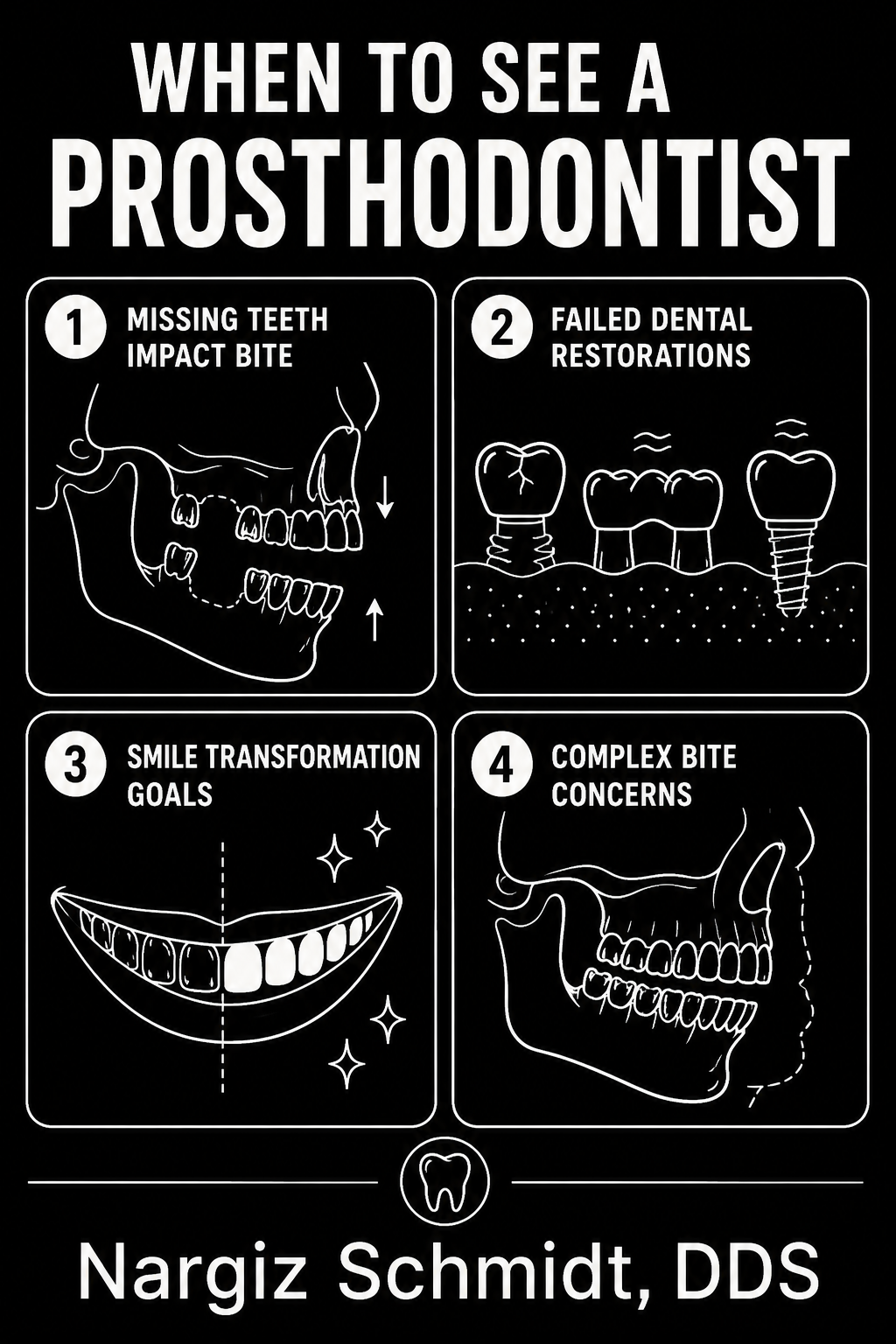
Several situations call for the depth of training a prosthodontist brings. The following circumstances commonly lead patients to seek prosthodontic evaluation:
- Multiple missing teeth: Loss of several teeth affects bite alignment, jaw structure, and overall aesthetics, all of which benefit from coordinated specialist treatment.
- Failed or unstable restorations: Crowns, bridges, or implants placed elsewhere that have failed require careful evaluation and a precise plan to correct.
- Significant aesthetic concerns: Patients seeking substantial changes to the appearance of their smile benefit from a clinician trained in aesthetic proportion and dental material selection.
- Complex bite issues: When problems with jaw alignment, worn dentition, or temporomandibular concerns intersect with restorative needs, a prosthodontist is best positioned to develop an integrated solution.
In each of these cases, the functional and aesthetic demands of care call for a clinician whose entire training has been centered on exactly these outcomes.
Why Choosing the Right Specialist Matters
The difference between a general dentist and a prosthodontist is not a matter of quality. It is a matter of training scope and the type of cases each clinician is best positioned to handle. Just as a family physician may refer a patient to a cardiologist when the complexity of care demands it, a thoughtful general dentist will often refer patients with advanced restorative needs to a prosthodontist.
At Manhattan Aesthetic Dentistry, Dr. Schmidt has dedicated her career to patients who have been told their cases are too complicated, have been passed among providers, or simply have never found a clinician able to deliver the outcome they deserve. Her multilingual team, fully digital workflow, and collaborative approach with a board-certified oral and maxillofacial surgeon mean that even the most involved cases can be managed in a single coordinated environment. We evaluate each patient with precision imaging and a comprehensive treatment plan that reflects both clinical reality and the patient’s individual aesthetic goals.
Find Out If a Prosthodontist Is Right for You
Understanding the distinction between a prosthodontist and a general dentist is the first step toward making sure your care matches the complexity of your needs. For patients with significant tooth loss, a history of failed restorations, or goals for a complete smile transformation, the right specialist can make a decisive difference in the outcome and long-term success of treatment.
Dr. Nargiz Schmidt, DDS, and the team at Manhattan Aesthetic Dentistry welcome patients from throughout Midtown East, the Upper West Side, and the greater New York metropolitan area. To schedule a consultation and learn whether prosthodontic care is the appropriate next step for your dental health, please reach out to our office through our contact form.